Nicholas Vasseghy
CEO,
Daryon Hotels International
July 2026
© 2026 Daryon Hotels International. All rights reserved. This document may be used, distributed, quoted, or referenced freely — in whole or in part — provided that credit is given to the author, Nicholas Vasseghy, and to Daryon Hotels International as the originating company. Attribution is not optional. Any use, republication, or distribution of this content without that credit is strictly prohibited and constitutes a violation of copyright.
The hotel industry is navigating a familiar pattern wearing an unfamiliar face. History shows that every major economic shock — the 1973 oil embargo, the 2008 financial crisis, COVID-19 — temporarily depresses hotel values before rewarding the operators who held on through the cycle. The families who bought distressed motels for $40,000 during the 1973 oil embargo saw returns of 4 to 40 times their investment in inflation-adjusted terms. The same pattern is available to today's operators — if they understand where the pressure is actually coming from.
That pressure is real and multi-front. Labor now consumes 30–40% of hotel revenue, and higher wages alone won't fix a retention problem that's fundamentally about management quality and workplace culture, not pay. Utility costs have become a genuine existential risk — a single monopoly provider can demand a six-figure emergency payment on-site with almost no warning. Insurance has nearly tripled at the top 25 U.S. markets since 2019, and losing coverage can mean losing a franchise agreement outright. Meanwhile, a widening technology gap is quietly costing hotels more in lost revenue than any visible line-item expense on the P&L.
This paper covers all of it — the historical pattern, the four cost pressures squeezing margins today, and a concrete playbook for the other side of the equation: turning housekeeping, maintenance, food and beverage, and empty guest rooms themselves into new, independent profit centers. An average 90-room hotel is sitting on roughly $1.1 million a year in unrealized revenue from unsold rooms alone. The six Hotel 2.0 recommendations in the final section are built specifically to capture that number, room by room, department by department.
The throughline is simple: crises are temporary, but well-managed hotel assets — and well-managed hotel businesses built around them — have historically proven resilient. Hotel 2.0 is not a rebranding exercise. It's the next stage of an industry that has reinvented itself before, and is doing it again.
Every operator reading this is already living one chapter of this story — rising labor costs, utility shocks, insurance that can shut a property down, technology gaps quietly bleeding revenue. History says the same crises that strain the industry today are exactly the ones that mint the next generation of hotel fortunes. The rest of this document is the playbook: what happened before, what's happening now, and six concrete ways to turn empty rooms and idle departments into profit centers.
The hotel industry doesn't hold still. Global upheavals, the domestic economy, pandemics, and bubbles have pushed it through wave after wave of change — from a lodging business, to a real estate business, and now toward something new again. Here's the short history of how we got here, and what's coming next. Move first. History rewards the operators who do.
Late 1960s through 1972 was one of the strongest expansion periods in modern U.S. hotel history. Economic growth, the Interstate Highway System, the rise of commercial aviation, and the emergence of branded hotel chains fueled it. Then the 1973–1974 oil embargo hit — and one of the industry's first major postwar downturns arrived with it.
This was the era Holiday Inn, Ramada, Howard Johnson, Best Western, and Quality Inn became household names on the American highway.
Here's what most people miss about that era: the vast majority of U.S. hotels and motels in the 1960s were mom-and-pop operations or small family-owned franchises. The 1960s were the golden age of the family motel — 20 to 80 rooms, planted along U.S. highways or in small towns, run by an owner, a spouse, and often the kids.
The 1973–1974 oil embargo was a geopolitical gut-punch. Several Arab oil-producing nations cut off exports to the United States and other countries, oil prices spiked, and fuel shortages spread coast to coast.
It hit mom-and-pop hotels and roadside motels hardest. The whole industry felt it, but small, owner-operated properties had less capital, less diversification, and total dependence on automobile travelers. Many buckled under the strain.
This is considered one of the most significant economic events of the 20th century — it exposed just how dependent industrialized nations had become on imported oil. Hotels along the interstate highways took some of the steepest declines of all.
Strong evidence points to something else, too: the 1973 embargo and the motel downturn it triggered created a unique buying opportunity — one that many Gujarati immigrants, including families expelled from Uganda, seized during the mid- and late 1970s.
Idi
Amin ruled Uganda from 1971 to 1979. In August 1972, he gave anyone of South
Asian ancestry 90 days to leave the country. Somewhere between 55,000 and
80,000 people were forced out — most with little more than what they could
carry, stripped of citizenship, property, and decades of built lives in a
single announcement. It was a genuine humanitarian crisis, not a footnote to
what came next.
Wikimedia Commons enhanced by Runway ML Nano Banana
In the mid-1970s, Patels — Patel being one of the most common surnames among Gujarati Indians, not a formal group or clan — began emigrating from India, Africa, and Asia to the United States, where any immigrant willing to invest $40,000 in a business could apply for permanent residence — the first step toward citizenship. Opportunities for that kind of investment were limited. But distressed roadside motels could be bought outright for exactly $40,000, right as the oil embargo gutted the industry and gas shortages crushed demand. (Source: famoushotels.org/news/Asian-American-hotel-owners-association)
Two historical events collided — and the collision reshaped the U.S. hotel industry.
The new owners brought business expertise and family labor to run these motels, and they brought modern accounting discipline to track the number that mattered most: cash flow. Four times cash flow became the Patel mantra. A distressed motel producing $10,000 a year in cash flow, bought for $40,000, was a profitable bet for a hard-working family — the math simply worked.
Four times revenue remains an established rule of thumb in the hotel industry today, especially for smaller properties.
The embargo officially ended March 17, 1974, once diplomatic progress convinced Arab oil-producing nations to lift it. The economic effects didn't end with it. Oil prices stayed several times higher than pre-crisis levels, inflation persisted, and the U.S. slid into a recession that kept squeezing hospitality. (Source: "Oil Shock of 1973–74," Federal Reserve History — federalreservehistory.org/essays/oil-shock-of-1973-74)
Many of these Gujarati immigrants — including families expelled from Uganda and East Africa — were highly experienced business owners with limited capital, starting over in North America.
The timing lined up perfectly. Small motel owners wanted out. Distressed motels sold cheap. Immigration rules rewarded exactly this kind of investment. And family labor — owners living on-site, doing the work themselves — cut operating costs dramatically.
By the late 1970s, and especially through the 1980s, domestic travel came roaring back. The Interstate Highway System was fully built out. The economy expanded. Roadside lodging demand recovered right along with it.
Owners who bought at depressed prices saw substantial appreciation in both income and property value. A motel purchased for $40,000–$100,000 in the mid-1970s could be worth several times that by the 1980s, once improvements and a stronger market kicked in.
The hoteliers who took the risk in the mid-1970s more than doubled their net worth in under a decade. That pattern repeated for generations: every economic upheaval since has driven hotel real estate values higher. A hotel bought for $40,000 during the oil embargo could be worth anywhere from $1 million to over $10 million today. Adjust that $40,000 for inflation alone and it's roughly $260,000–$280,000 in today's dollars — meaning the real, inflation-adjusted value of these properties still grew 4 to 40 times, averaging around 20 times.
The same pattern followed the second oil shock in 1980, the late-1980s savings-and-loan crisis, the 1990 Gulf War recession, the 2001 Afghanistan War, the 2008 Great Recession, COVID-19 in 2020, and now the 2026 disruption of Middle East oil deliveries.
The through-line across modern U.S. history: major economic shocks cause temporary declines in hotel values. Owners who bought or held well-located hotels through the downturn, and made it to the recovery, saw substantial long-term appreciation — in both property value and operating income.
The lesson for today's owners is direct: crises are temporary. Well-managed hotel assets are not. Operators who weather this cycle are the ones positioned to win the next one.
The industry is navigating another hard chapter. Travel demand has largely returned — but hotel owners are still facing elevated labor costs, inflation, expensive financing, inconsistent new construction, and ongoing geopolitical uncertainty. That pressure is straining plenty of properties, especially ones carrying heavy debt or needing major capital work.
The industry is navigating another hard chapter. Travel demand has largely returned — but hotel owners are still facing elevated labor costs, inflation, expensive financing, inconsistent new construction, and ongoing geopolitical uncertainty. That pressure is straining plenty of properties, especially ones carrying heavy debt or needing major capital work.
History doesn't repeat exactly. It rhymes. Uncertainty slows new construction, thins out competition, and opens acquisition windows for well-capitalized buyers. As conditions stabilize and travel normalizes, quality hotels in strong markets stand to benefit from limited new supply meeting renewed demand.
That's not a hopeful theory. It's the same pattern, showing up again, for anyone paying attention.
The U.S. hotel industry has largely recovered from COVID-19's demand shock. Guests are back. Occupancy has improved. In many markets, average daily rates have matched or beaten pre-pandemic levels. The financial recovery hasn't followed.
Today's challenge isn't attracting travelers. It's staying profitable.
Operating costs are outrunning revenue across much of the industry. Labor is the biggest pressure — wage increases well beyond historical norms, as operators compete for a shrinking workforce. Insurance premiums have spiked in many markets. Utility costs have become unpredictable. Supplies, maintenance, and replacement equipment keep climbing in price. Municipalities keep raising property taxes and other operating costs on top of it.
Inside our own portfolio: labor costs up more than 30%. Insurance premiums doubled at some properties. Utility costs tripled at one hotel. Taxes and supply costs climbing steadily across the board. Every market is different, but the pressure is real everywhere.
The result is a new reality: healthy occupancy, respectable revenue, and significantly lower profit margins than just a few years ago. Revenue growth alone doesn't cut it anymore if expenses keep outpacing it.
Periods like this tend to trigger consolidation. Rising financing costs, slower construction, and compressed profits separate well-capitalized, professionally managed hotels from the ones drowning in debt or deferred maintenance. As in every prior cycle, the operators who embrace technology, control expenses, and run a tight operation come out stronger on the other side.
The next chapter won't be written by occupancy or ADR. It'll be written by who can adapt to a business environment where the real challenge isn't demand. It's innovation-driven profitability.
PKF Hospitality Research's Robert Mandelbaum found labor costs averaging 32.1% of total hotel revenue and 44.5% of operating expenses for the typical U.S. hotel. (Source: hotelnewsresource.com/article33202.html)
More recent guidance widens that range to roughly 30%–40% of revenue, depending on property type and service level. Actabl, citing the same Mandelbaum research, puts labor at 30%–40% of hotel revenue — or about half of operating expenses. (Source: actabl.com/blog/why-labor-is-the-1-hotel-expense-you-can-control)
The modern job market looks like it's thriving — countless openings, an endless stream of applicants. Yet employers, especially in hospitality and other entry-level industries, keep struggling with high turnover, poor applicant quality, and employees who leave within weeks.
Many economists blame a labor shortage or low wages. Competitive pay matters — but the research says the real issue runs deeper. Digital recruiting platforms and basic human psychology have rewired the labor market entirely, creating what's best called the Churn Illusion.
LinkedIn's Easy Apply and Indeed's one-click applications made job hunting nearly effortless. An applicant can fire off dozens of applications in minutes, often with no real intention of taking or keeping any specific job. The flood of applications goes up. The percentage of qualified, committed candidates goes down.
It shows up hardest in hospitality, retail, and other service industries. Employees routinely leave within the first 30 to 90 days, so the same position gets reposted again and again. Labor statistics count each posting as a new opening. In reality, it's often the same job cycling through different people — not genuine employment growth.
The default response is to raise wages. Organizational psychology has known for decades that compensation alone has limited power over long-term retention.
Frederick Herzberg's Two-Factor Theory calls salary a hygiene factor — it prevents dissatisfaction, but it doesn't build lasting engagement or loyalty. Self-Determination Theory (Deci & Ryan) backs that up: employees stay committed when three psychological needs are met — autonomy, competence, and belonging. Strip those away, and quitting becomes the one form of control an employee still has.
Modern research backs the theory with hard numbers. Gallup found employees who receive high-quality recognition are 45% less likely to leave over a two-year period — and meaningfully more engaged while they stay. Gallup also found pay and benefits account for only about 16% of the primary reasons employees give for leaving. Career growth, leadership, job fit, and workplace culture make up the much larger remainder.
Hospitality-specific research lands in the same place. Studies from Cornell's Peter and Stephanie Nolan School of Hotel Administration (Center for Hospitality Research) consistently find that supportive supervisors, recognition, scheduling flexibility, career development, and workplace culture predict long-term retention better than pay increases alone.
The fix is redesigning the work experience — not just raising wages. Give employees real autonomy. Recognize individual contributions. Build relationships that matter. Provide growth and cross-training. Show people how their work actually contributes to the organization's success.
Competitive pay is still necessary. It's just the starting point, not the finish line. Organizations that pair fair wages with recognition, purpose, empowerment, and real leadership retain people, cut turnover, and build a workforce that's actually engaged. The retention crisis was never a labor shortage. It's a workplace design problem.
Hotel operators used to treat utilities — electricity, water, sewer, gas — as predictable expenses. Aging grid infrastructure, regulatory shifts, and the surging power demands of AI and data centers have turned that line item into one of the industry's most volatile risks.
General inflation drives steady, manageable increases. What's new is the exposure to “black swan” utility events — sudden, catastrophic cost spikes that can cripple cash flow at exactly the moments a hotel needs it most: peak revenue periods.
Industry-wide trends only tell part of the story. They don't capture the extreme cost shocks that hit individual properties — and because many hotels operate under a single-provider utility monopoly, they have no leverage to negotiate or switch suppliers when billing turns punitive.
One case shows exactly how exposed the industry is: a hotel saw a 200% increase in electricity costs, with monthly bills jumping from $11,000 to $33,000 — with no prior explanation.
It
escalated into a direct threat to the hotel's survival. On a high-revenue
Friday, a utility representative showed up on-site with a portable credit card
reader, demanding an immediate $350,000 payment to avoid an instant power
shutoff. To avoid a catastrophic failure during a weekend full of events, the
hotel paid $140,000 on the spot, then another $150,000 the following week. When
management pushed back on the abrupt “backbilling,” the answer they got back
was the reality of monopoly power, in four words: “It is what it is.”
The hotel has requested anonymity due to the possibility of litigation.
Timing Risk — Sudden demands tend to strike during peak occupancy or event weekends. A utility provider threatening to cut power during a sold-out conference creates a hostage situation: pay, or watch the hotel's reputation take the hit.
Lack of Transparency — Operators get blindsided by backbilling and rate changes that show up with little to no documentation, which makes accurate financial forecasting close to impossible.
Operational Dependency — A hotel can't just pause. A shutdown wrecks the guest experience, damages brand reputation, and creates irreparable losses for scheduled events.
Utility costs stopped being a routine cost of doing business. They're now a potential source of existential risk — which makes proactive management essential, not optional.
• Rigorous Bill Auditing — Do not assume the utility bill is accurate. Regularly analyze spending records for anomalies, redundancies, and incorrect tariff applications that lead to hidden overpayments.
• Leverage Technology — Adopt AI-powered energy management systems to monitor usage in real time, reduce peak demand charges, and optimize energy-intensive activities.
• Strategic Infrastructure Investments — Transition to energy-efficient systems (LEDs, smart HVAC controls) and explore on-site renewable energy like solar to buffer against grid instability and price volatility.
• Relationship Management — Maintain active communication with utility account managers. They may hold significant power, but clear communication can sometimes prevent the “surprises” of backbilling or abrupt collection demands.
Utility costs have become one of the most stressful variables in hospitality. Treat it as a strategic risk, not a fixed line item, and operators protect their margins, their reputation, and their sleep.
No hotel operating expense has climbed more dramatically or more consistently than insurance. Between 2019 and 2024, insurance expense per hotel key rose by an average of roughly 195% across the top 25 U.S. markets. Annual growth peaked around 20% in mid-2023. Some high-risk properties saw increases of 25% to more than 100% in just one to three years. (Source: "Weather Risks and Rebuilding Costs Drive Soaring Hotel Insurance Premiums," CoStar — costar.com/article/1515295770)
Several forces drove it: greater climate and weather-related risk, rapidly rising rebuilding and construction costs, a wave of large litigation awards known as “nuclear verdicts,” and reduced insurance-carrier capacity in prior years. Property insurance absorbed the largest share of the increase.
By 2025 and into early 2026, property insurance premiums started to moderate in certain segments — down roughly 10% year over year in Q1 2026 in some markets, thanks to improved reinsurance capacity. The relief hasn't been even. Casualty and liability coverage kept climbing 8% to 9% annually, keeping total insurance costs elevated for most operators.
Beyond the direct cost increases, insurance companies now hold real control over whether a hotel stays in business. Marriott, Hilton, IHG, and other major franchisors require extensive coverage as a non-negotiable condition of their franchise agreements.
The requirements typically include high coverage limits for property insurance, general liability, and umbrella liability — often layered with cyber liability, liquor liability, and workers' compensation on top.
When an insurer refuses to underwrite or renew coverage — for any reason — the property lands in an impossible spot fast. No required coverage means breach of the franchise agreement. The franchisor can terminate it outright, forcing the hotel to either go independent at a severe competitive disadvantage, or shut down completely.
That's a dangerous dependency. Hotels aren't just paying higher premiums — they're at the mercy of insurers who can decide, with little notice, that a property is simply too risky to cover.
Location in a high-weather-risk area, claims history, building age, or broader market conditions can all trigger non-renewal. When it happens, owners scramble for replacement coverage at dramatically higher rates — assuming coverage can be found at all.
Rapidly rising premiums, stacked on the existential threat of losing coverage entirely, have put enormous pressure on owners and operators. Insurance budgets have doubled or tripled at many properties within a few years — cash flow that could have gone to staffing, maintenance, renovations, or the guest experience instead.
Insurance functions as an operational gatekeeper. Franchise agreements require continuous coverage; jurisdictions, lenders, landlords, and liquor authorities each layer on their own requirements. Cancel or fail to renew, and a franchisor can suspend or terminate the franchise fast, pull the property from the reservation system, and demand the flag come down. Depending on local law, the hotel can lose its legal or practical ability to operate entirely.
It's most severe for independent hotels and smaller operators without the negotiating power of large ownership groups. Even a well-managed hotel can get penalized by factors entirely outside its control — regional weather patterns, industry-wide claims trends.
Property insurance rates have moderated somewhat. The overall environment is still fragile. Liability costs keep rising, and the fundamental imbalance of power — insurers effectively holding the keys to whether a hotel can operate at all — shows no sign of easing.
Insurance has gone from a manageable line item to one of the most unpredictable, highest-stakes numbers on the P&L. Shopping for a competitive rate isn't managing this risk anymore. Proactive mitigation, disciplined claims management, and a real contingency plan for the day coverage disappears — that's what managing it actually looks like now.
Technology keeps advancing across hospitality. Plenty of hotels keep falling further behind — not because the tools don't exist, but because they can't find qualified staff to implement and manage them. That lag doesn't just fail to save money. It actively drives operating costs up, while quietly causing something worse: the inability to capture new business or keep the business they already have.
At the corporate and management-company level, digital capability has genuinely advanced. Most management companies now run sophisticated systems for real-time reporting, performance analytics, revenue management, and operational dashboards — tools that drive faster decisions, better forecasting, and measurable gains in both revenue and cost control.
At the individual property level, the picture looks different. Many hotels still run on outdated templates copied and overwritten on repeat, or basic spreadsheets that became the default way of managing operations. Manual processes like these pile on workload, introduce errors, slow everything down, and blunt the ability to react to a changing market.
Hiring qualified staff compounds the problem. As technology evolves — AI-driven tools, automated reporting, cloud-based systems, integrated platforms — properties need people who can implement, manage, and optimize all of it. Many hotels stay short-staffed, without anyone on the team who has the technical skill to close that gap.
So hotels stay locked into older, less efficient ways of operating. That doesn't save money. It costs more. Manual processes eat more labor hours to do the same work, and errors from outdated systems create additional work just to fix them. In plenty of cases, failing to adopt modern technology costs more than the technology itself ever would have.
In our own experience, rolling out technology that genuinely makes hotel jobs easier still runs into resistance every time. Even systems built specifically to cut repetitive work and improve accuracy get adopted slowly, or not fully at all. Employees already stretched thin see new technology as one more burden, not a solution — especially when training and ongoing support don't show up alongside it.
That
resistance feeds itself. Without effective technology, daily operations stay
labor-intensive and error-prone. That drives up workload and frustration, which
makes it even harder to attract and keep the talent needed to implement and
sustain modern systems in the first place.
The biggest consequence of this lag isn't the visible bump in operating costs. It's the hidden damage to revenue.
Hotels running on outdated systems and manual processes lose the ability to respond quickly to market opportunities, deliver the modern guest experience travelers now expect, price in real time, or compete with properties that have actually embraced digital tools. The result: missed new business, and a fight just to hold onto the guests they already have.
That lost revenue — missed bookings, lower conversion, declining guest satisfaction, competitors picking up market share — often hits overall financial performance harder than every direct operating cost increase discussed above, combined. Unlike a visible expense line, this loss stays hidden. It never shows up on the P&L as a “technology inefficiency expense.” It just quietly erodes revenue growth, market share, and long-term competitiveness.
In plenty of cases, the long-term financial impact of falling behind on technology far exceeds the short-term cost of operational inefficiency. Hotels dependent on outdated processes don't just run less efficiently. They gradually lose the ability to win and keep business in an increasingly digital marketplace.
The widening gap between what technology makes possible and what most hotels actually do creates a double burden: higher operating costs from manual workarounds, stacked on significant, often invisible, revenue leakage.
Closing that gap takes more than buying new software. It takes real investment in training, change management, and people who can bridge traditional hotel operations with modern digital tools. Without that progress, hotels keep paying more to operate while quietly losing the business they need to survive.
History disagrees. What looks impossible today routinely becomes tomorrow's standard, and forward-thinking operators have consistently hit results everyone else assumed were out of reach.
Hear the idea out before dismissing it. It challenges conventional thinking — and it could fundamentally change how a hotel operates.
In
short: we're going to turn cost centers into profit centers. The obvious
question is why no one did this already. The honest answer — sometimes the
opportunity was always sitting there, waiting for someone to actually bottle
it. This is hospitality's version of the Chattanooga bottling deal.
Your hotel already has the staff, the industrial laundry, the supplies, the training systems, and the operational know-how. The only thing missing is putting them to work for extra money. Launch a professional cleaning service for homes, offices, and local businesses, and the housekeeping department stops being a cost center and starts being a profit machine. Done right, this diversification covers your own cleaning costs, improves staff retention, markets the hotel to the community, and builds a new income stream — for minimal extra investment.
Month 1: Create a
service checklist and train 4–6 existing staff on residential/office work.
Month 1–2: Get extra
insurance (higher liability for homes), a business license if needed, and a
basic website/booking form.
Month 2: Start with 5–10
recurring residential clients plus 1–2 small offices.
Month 3+: Add marketing
— Google Business, Nextdoor, local Facebook groups, hotel guest referrals.
The hotel maintenance shop usually has a clear advantage over local handyman businesses when it comes to tools and equipment. It runs its own organized workshop with plenty of storage and a large stock of common replacement parts — faucets, light fixtures, door handles, filters. Because the hotel needs everything running smoothly 24/7, it can invest in specialized commercial-grade tools most regular handymen don't have. Plenty of handymen do good work and keep their tools organized in a van, but they're limited by space and weight — often left with just the basics, without the depth of a full workshop.
You already have the expertise, the tools, the workspace, and in many cases a certified team. Your maintenance department is already ahead of most local handyman contractors.
This is a smart, realistic move. Turn the maintenance department into an independent business that keeps serving the hotel while also offering services to the local community. Make it an independent LLC or simply a DBA, and you can move the payroll out of the hotel's general payroll and into the new maintenance business. That gives more flexibility to hire additional staff, more variety in jobs, better cash flow — and more help available for the hotel when it's needed. A department that used to be a constant cost becomes a profit center, or at minimum, pays for itself.
Be honest — how often do tools and materials sit unused in storage because they were over-ordered? Turning those items into cash is another real benefit.
Once
the maintenance team becomes an independent business, it carries its own
insurance and handles its own payroll. That can reduce the hotel's overall
insurance costs while giving the new business proper protection for work done
both inside and outside the hotel.
Hotel restaurants often struggle to make money. High labor costs, low customer counts, and rising food expenses make profitability hard to reach on their own. Many hotels end up quietly subsidizing their restaurants with revenue from rooms and events.
A 2019 study in the journal Tourism Management found food and beverage operations in U.S. hotels typically earn only about 31% operating profit, compared to 74% for rooms — the gap driven mainly by much higher labor costs in restaurants. A 2023 research paper on managing hotel F&B highlighted the same ongoing operational challenges.
We saw this problem clearly in our own hotels.
In one property with two restaurants and a bar, the restaurant was losing badly. One evening around 6 PM, two guests stood waiting at the “Please Wait to Be Seated” stand for over five minutes. The restaurant was completely empty. When we checked the kitchen, all four staff members — including the cooks — were chatting instead of working. That same hotel ran breakfast, lunch, and dinner, yet its restaurant costs ran four times higher than its revenue. Lunch service basically existed to feed hotel staff for free. The only fix was to close the restaurants completely and start fresh.
In another hotel, the restaurant was already shut down when we took over — costs were far too high against income. We reopened it as a pizzeria with just two part-time staff on a profit-sharing arrangement, added delivery, and put up external signage. It went profitable fast — not just covering its costs, but making money. We've used the same approach in most of our hotels with F&B outlets, and every one of them succeeded.
The lesson is simple: hotel restaurants, even inside a hotel, have to operate like independent, outward-looking businesses. They can't rely mainly on hotel guests for business.
When we focused on delivery, takeout, and attracting local customers, the restaurants became profitable — and they helped market the hotel to the outside community. A hotel pizzeria has real structural advantages: no franchise fees like a standalone pizzeria pays, no separate rent or full utilities, plus extra income from hotel guests happy to pay more for the convenience of eating in or ordering from their room. There's no reason a well-run hotel restaurant — especially a pizzeria — can't turn a profit, if it looks beyond hotel guests and runs like a real standalone business.
This approach also adds to a hotel's local exposure, and to room and event revenue.
Rethink the restaurant. Make it its own entity, with its own payroll. It works.
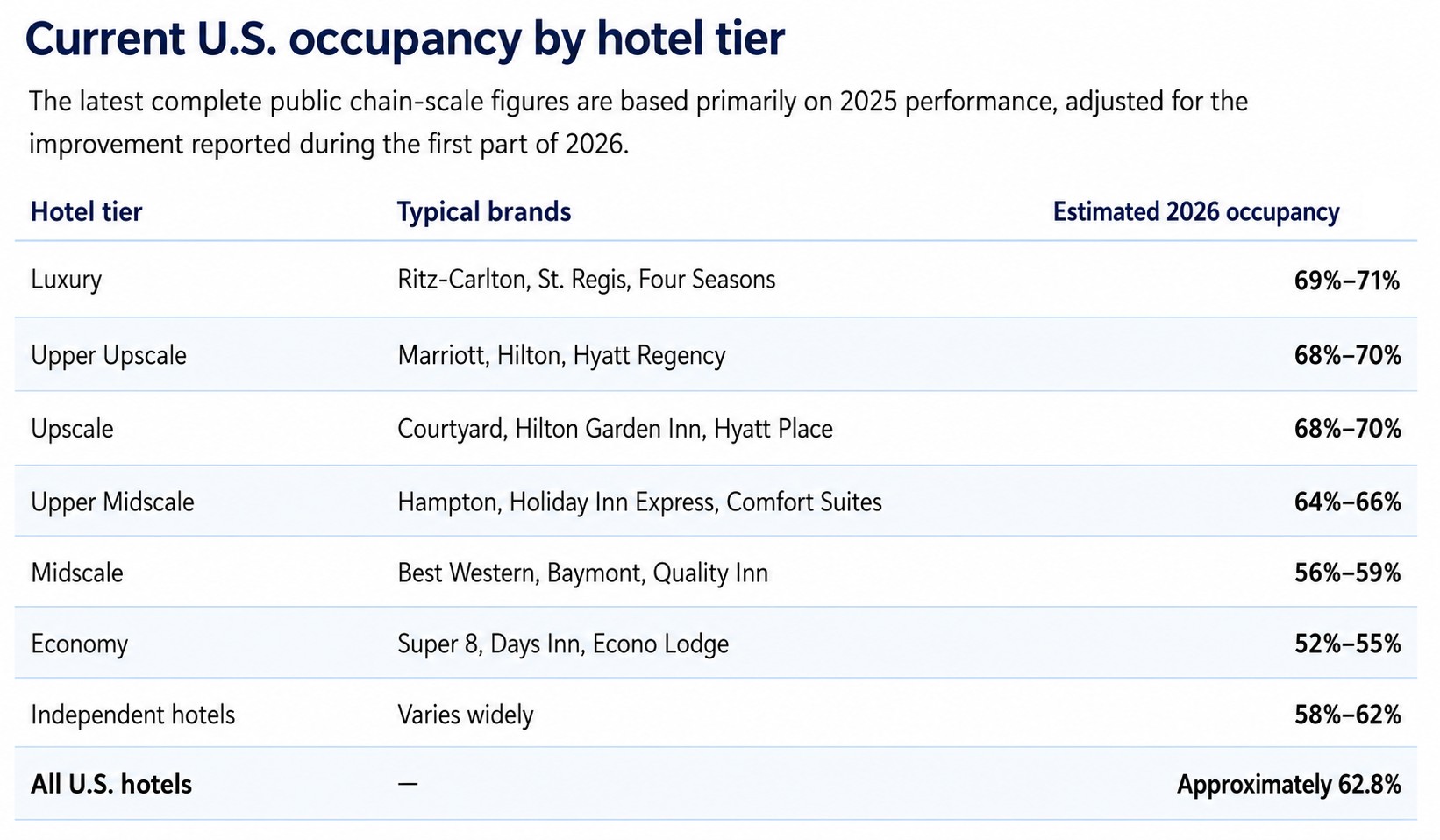
The highest hotel occupancy for 2026 belongs to upper-scale and luxury hotels, at about 70%; that drops to about 55% for midscale hotels. (CoStar/Tourism Economics forecast and CBRE first-quarter analysis, 2026.)
Only 14% of hotels qualify as luxury and upper-scale; the rest, excluding independent hotels, account for about 62%.
The Colliers 2026 Outlook projects hotel occupancy over the next 10 years will hold roughly steady, at about 60% to 65%.
That means for an average 90-room hotel, an average of 34 rooms sit vacant throughout the year. At an average RevPAR of $85, an average 90-room hotel is looking at about $1.1 million in unrealized revenue from unsold rooms.
The hotel still pays franchise fees, its mortgage, and every other fixed cost for those 12,400 unsold room-nights a year.
It's
time to put those precious spaces to better use. The six sections that follow
each break down one way to do it.
Turn a couple of rooms behind the front desk into a mail-handling and business-services center — The UPS Store, the former Mail Boxes Etc., FedEx, PostNet, and others all fit the model.
These stores gain real advantages inside a hotel: they can run 24/7, and they add a serious amenity for corporate travelers who need to ship a package, print a document, or grab office supplies without leaving the building.
The target market is broader than it looks. Corporate travelers need shipping and printing on short notice. Local small businesses and e-commerce sellers need a reliable drop-off point with longer hours than the post office. Neighborhood residents need notary services, mailbox rentals, and packaging supplies. A hotel lobby with 24/7 access covers all three markets a standalone location structurally can't.
Caveat: these stores must be accessible directly from outside and operate as a community business — not focused on serving hotel guests. Just like with hotel restaurants, these have to primarily serve the community, or they fail the same way.
The UPS Store carries a market capitalization of up to $5 billion, based on $720,000 in gross sales for the average store — larger than some hotel franchise companies. Imagine building that into hotels.
Regus, Alliance Virtual Offices, and Davinci run on a real estate model at the core — but by bundling in virtual offices and short-term office rentals, they've converted fixed physical overhead into a flexible, scalable utility for businesses.
The modern business environment leans heavily on virtual offices to bridge the gap between flexible remote work and rigid legal, banking, and professional infrastructure. Hotels are perfectly positioned to capture that market.
Convert a couple of rooms into short-term business cubicles and rent them the way virtual offices already do nationwide and globally. Hotels bring a real edge here too — open 24/7, already stocked with amenities standard flexible-work offices can't provide.
The revenue model layers naturally: a monthly registered-business-address fee for local entrepreneurs who need a professional mailing address, an hourly or day-rate cubicle fee for traveling professionals between meetings, and a meeting-room day rate for small businesses that need a conference space without leasing one year-round.
Add
digital technology to the service — app-based booking, keyless entry,
video-conferencing setups — and hotel-based virtual offices become far more
attractive than the competition.
Convert a couple of first-floor rooms into outward-facing coffee shops, deli cafes, or pizza shops. They only thrive if they're public-facing, don't rely at all on hotel guests, and don't need to be part of the hotel entity.
This is the same lesson the hotel-restaurant turnaround section already proved out: food and beverage inside a hotel only works as a real business when it's built for the neighborhood, not the guest list. A street-facing coffee counter with its own entrance, its own signage, and its own hours pulls in the morning commuter crowd and the after-work crowd — traffic a hotel guest list alone could never generate.
The economics favor the hotel over a standalone competitor for the same reasons the pizzeria turnaround worked: no separate rent, shared utilities, and a built-in customer base of hotel guests happy to pay a convenience premium on top of the local walk-in business the space is actually built to serve.
Most hotels already run small gift shops making thousands to tens of thousands serving hotel guests alone — so why not the public? How often does someone need something at 2 AM with no store open to sell it to them? A simple conversion, making the hotel convenience store attractive to the community, is a hugely profitable move.
Hotel convenience stores conservatively make a minimum of $50,000 a year; going public-facing could conservatively bring in about $300,000 (a typical convenience store without a gas station makes $600,000 to $1 million). The profit margin on a hotel convenience store runs far larger than a standard one — about 20% versus only 5%. Empirically, most convenience stores in our hotels show a 50% profit margin.
The operational lift is smaller than it looks. Existing overnight front-desk staff can run point-of-sale during slow hours, inventory can start small and scale with demand, and product selection should skew toward what a 2 AM walk-in actually needs — basic groceries, medicine, phone chargers, snacks — not a full grocery assortment.
Bottom line: if someone wants cream at 3 AM, they won't mind paying three times the price for it.
Converting one room into a public-facing hair salon is another solid option. Per the SBDC Industry Overview, the average hair salon in 2026 generated $317K in annual revenue — even renting the room out for the full year instead of leaving it vacant would generate about $25K.
The lowest-risk way to run this is a booth-rental model, the standard structure most salons already use: independent stylists rent a chair and keep their own client base and pricing, while the hotel collects rent and a share of related product sales. That structure moves nearly all the staffing and scheduling risk off the hotel's books while still capturing the space's upside.
The target customer splits two ways: business travelers who want a real haircut or grooming service without leaving the property, and local clients who already have a relationship with the stylist renting the chair and simply follow them to the new location.
Plenty of other options exist depending on the hotel's location and market — cell phone service and repair kiosks, laundry and dry-cleaning drop-off, tailoring and alterations, vending and micro-retail, even a small fitness studio selling public memberships. None of these require reinventing the model above: find a service the neighborhood already needs, make it genuinely public-facing, and let the hotel's location and operating hours do the rest.
Bottom line: nearly anything is more feasible than leaving rooms vacant all year long.
These are some of the ways hotels can put their space to better use — not just creating extra income, but making the hotel more attractive to travelers in the process.
Cities with less restrictive ordinances will see higher tourism revenue and employment. Brands that facilitate a multifaceted approach to hotel operations will draw more investor interest. And the investors who spot the opportunity in pragmatic ideas will outrun their competition.
There's no logical reason to leave rooms vacant when the historical trend and the forecast both say about 35% of rooms will sit empty on average every year.
The disruption in the hotel industry never really stops. If history is any guide, the operators who embrace change, innovation, and vision are the ones who steer this massive train forward. Opportunities abound. Get on with it.
Daryon Hotels has extensive, pragmatic experience with this innovative approach and has tested it across different hotels — we know the challenges and the rewards firsthand. Our management company has a track record of growing hotel revenue and capturing lost revenue year after year, which, over a hotel's lifetime, adds up to tens of millions of dollars per property.
Hotel 2.0 is here.